

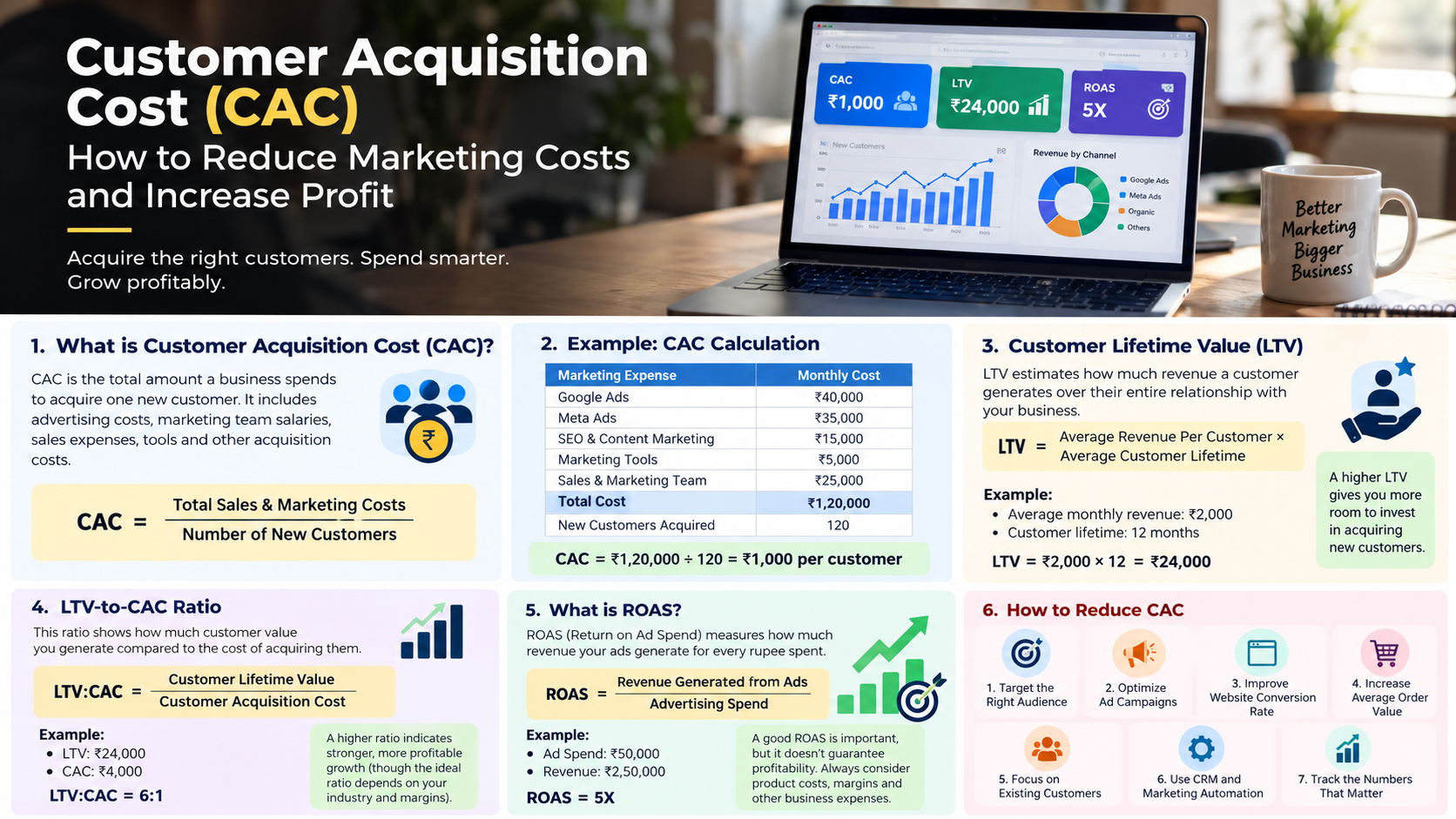
Every business wants more customers. But getting those customers at the right cost is what really makes a difference.
Think about it. Your business is spending ₹1 lakh every month on Google Ads, Meta Ads, SEO and other marketing activities. Website traffic is increasing, enquiries are coming in, and campaigns are generating leads. But at the end of the month, how many of those leads actually become paying customers? And how much did it cost to acquire each one?
These are questions every business owner and marketing manager should be asking.
This is where Customer Acquisition Cost (CAC) comes into the picture.
CAC helps you understand how much your business spends to bring in one new customer. More importantly, it helps you identify whether your marketing efforts are generating real business value or simply consuming your budget.
The goal isn’t always to spend less on marketing. Sometimes, spending more on the right audience, improving your website or fixing your sales process can actually make customer acquisition more profitable.
Let’s understand how CAC works and what businesses can do to improve it.
1. What Is Customer Acquisition Cost (CAC)?
Customer Acquisition Cost, commonly known as CAC, is the amount of money a business spends to acquire one new customer.
This includes more than just advertising costs. It can also include marketing team salaries, sales expenses, agency fees, software subscriptions and other costs involved in bringing a customer to the business.
Let’s take a simple example.
Imagine an ecommerce company spends ₹1,00,000 on its sales and marketing activities in a month. During that month, it acquires 100 new customers.
The calculation is simple:
CAC = Total Sales and Marketing Costs ÷ Number of New Customers
₹1,00,000 ÷ 100 = ₹1,000
So, the company spends ₹1,000 to acquire each new customer.
This number gives the business a starting point to evaluate its marketing efficiency.
If the company is spending ₹1,000 to acquire a customer but earning only ₹700 in contribution from that customer’s purchase, there may be a profitability problem.
Understanding CAC helps businesses identify such gaps before increasing their marketing budgets.
2. How to Calculate Customer Acquisition Cost
Calculating CAC is easy. Getting the numbers right is what matters.
Many businesses calculate their acquisition cost using only Google Ads or Meta Ads expenditure. However, this doesn’t always reflect the actual cost of acquiring a customer.
A more realistic calculation should include all relevant sales and marketing expenses.
These may include:
- Google Ads and Meta Ads budgets.
- SEO and content marketing expenses.
- Social media management costs.
- Marketing and sales team salaries.
- Agency and freelancer fees.
- CRM and marketing automation tools.
- Creative design and video production.
- Sales commissions and related expenses.
A practical example
Suppose an ecommerce business has the following monthly expenses:
| Marketing Expense | Monthly Cost |
|---|---|
| Google Ads | ₹40,000 |
| Meta Ads | ₹35,000 |
| SEO & Content Marketing | ₹15,000 |
| Marketing Tools | ₹5,000 |
| Sales & Marketing Team Allocation | ₹25,000 |
| Total | ₹1,20,000 |
If the business acquires 120 new customers:
CAC = ₹1,20,000 ÷ 120 = ₹1,000
The actual customer acquisition cost is ₹1,000.
This is a more useful figure than looking at advertising expenditure alone.
One important thing to remember: calculate CAC over a consistent period and count only new customers. Also, avoid mixing existing customer purchases with new customer acquisition when measuring performance.
3. Customer Lifetime Value (LTV): The Other Side of Customer Acquisition
Getting a customer is important, but what happens after the first purchase?
Does that customer come back? Do they recommend your business to others? Do they continue buying your products or services?
This is where Customer Lifetime Value (LTV), also known as CLV, becomes important.
LTV estimates how much revenue a business can generate from a customer throughout their relationship with the company.
For example, consider a subscription-based business:
- Average monthly revenue per customer: ₹2,000
- Average customer lifetime: 12 months
LTV = Average Monthly Revenue × Customer Lifetime
₹2,000 × 12 = ₹24,000
The estimated customer lifetime revenue is ₹24,000.
For ecommerce businesses, repeat purchases, average order value and purchase frequency also help estimate customer lifetime value.
Why does this matter?
Because acquiring a customer for ₹2,000 may look expensive initially. But if that customer generates ₹20,000 in revenue over time, the acquisition investment may make sense.
The important thing is to understand not just what customers spend today, but the value they bring to your business over time.
4. What Is the LTV-to-CAC Ratio?
Once you understand CAC and LTV separately, the next step is to compare them.
The LTV-to-CAC ratio tells you how much customer value your business generates compared with the cost of acquiring that customer.
LTV = Customer Lifetime Value ÷ Customer Acquisition Cost
For example:
- Customer Lifetime Value: ₹24,000
- Customer Acquisition Cost: ₹4,000
₹24,000 ÷ ₹4,000 = 6
LTV Ratio = 6:1
This means the business generates ₹6 in estimated customer lifetime revenue for every ₹1 spent on acquisition.
A 3:1 ratio is often used as a reference point in SaaS businesses, but it isn’t a universal target for every industry.
A good ratio depends on your profit margins, repeat purchases, customer retention, cash flow and business model.
The real objective is to acquire customers at a cost that allows your business to grow while maintaining healthy profitability.
Note: LTV in this example represents revenue, not profit. For a stronger profitability analysis, consider gross-margin-adjusted LTV.
5. Understanding ROAS and Its Connection with CAC
If you are running Google Ads or Meta Ads campaigns, you have probably come across the term ROAS.
ROAS stands for Return on Ad Spend. It measures how much revenue your advertising generates compared with the amount spent on ads.
ROAS = Revenue Generated from Advertising ÷ Advertising Spend
For example:
- Google Ads expenditure: ₹50,000
- Revenue generated: ₹2,50,000
₹2,50,000 ÷ ₹50,000 = 5
ROAS = 5X
This means every ₹1 spent on advertising generates ₹5 in attributed revenue.
Sounds good, right? But there is something important to understand.
A 5X ROAS does not automatically mean your business is profitable.
You still need to account for product costs, shipping, discounts, payment gateway charges, returns and other operating expenses.
CAC vs ROAS: What’s the Difference?
| Metric | What It Tells You |
|---|---|
| CAC | How much it costs to acquire a new customer |
| ROAS | How much advertising revenue is generated per rupee spent |
| LTV | How much revenue a customer may generate over time |
| ROI | Whether the overall investment generates a return |
These metrics work best when viewed together.
A campaign might generate excellent ROAS but attract mostly existing customers. Another campaign might generate a lower ROAS but bring in valuable new customers who make repeat purchases.
That is why looking beyond advertising dashboards is essential.
6. Seven Practical Ways to Reduce Customer Acquisition Cost
Reducing CAC doesn’t always mean cutting your advertising budget.
In many cases, the bigger opportunity is to make your existing marketing investment work harder.
Here are seven practical ways businesses can improve customer acquisition efficiency.
1. Target the Right Audience
One of the most common reasons businesses waste their marketing budget is that they try to reach too many people.
Getting thousands of clicks is not useful if those visitors have no intention of buying.
Start by understanding your actual customers.
Look at their location, interests, purchasing behaviour, requirements and the reasons they choose your product or service.
For Google Ads, focus on high-intent keywords and regularly review search terms.
For Meta Ads, experiment with different audience segments, creatives and messaging.
Also, use remarketing to reconnect with people who have already visited your website or interacted with your brand.
The idea is simple: reach people who are more likely to become customers instead of paying for irrelevant traffic.
2. Make Your Advertising Campaigns More Effective
Running ads is easy. Making them profitable requires continuous attention.
A campaign that performs well today may become less effective next month because of changing competition, audience behaviour or creative fatigue.
For Google Ads, regularly review:
- Search terms and negative keywords.
- Keyword intent and campaign structure.
- Conversion tracking.
- Bidding strategies.
- Ad relevance and landing page experience.
For Meta Ads, focus on:
- Testing different creative concepts.
- Improving ad copy and messaging.
- Monitoring audience quality.
- Refreshing creatives regularly.
- Tracking actual purchases and qualified leads.
Don’t judge campaigns only by clicks, impressions or low cost per lead.
The more important question is whether those campaigns are bringing in customers who contribute to business revenue.
3. Improve Your Website Conversion Rate
Imagine spending ₹50,000 on advertising and bringing 5,000 visitors to your website.
But most visitors leave without making a purchase or submitting an enquiry.
Would increasing the advertising budget solve the problem?
Probably not.
Before spending more money to bring additional visitors, look at what is happening on your website.
Are your product pages convincing? Is the website easy to navigate? Does it load quickly on mobile? Is the checkout process simple?
These small issues can have a big impact on conversions.
Focus on improving:
- Website loading speed.
- Mobile experience.
- Product descriptions and images.
- Landing page content.
- CTA buttons.
- Customer reviews and trust signals.
- Checkout and enquiry forms.
- Payment options.
This is where Conversion Rate Optimization (CRO) becomes valuable.
Even a small improvement in conversion rate can help a business generate more customers from the same advertising investment.
4. Increase Average Order Value
Another way to improve acquisition efficiency is to increase the amount customers spend on each purchase.
For example, if your average order value is ₹3,000, look for opportunities to increase it to ₹4,000.
This can be done through:
- Product bundles.
- Complementary product recommendations.
- Premium product upgrades.
- Cross-selling and upselling.
- Free shipping thresholds.
- Special offers on larger orders.
For an ecommerce business selling furniture, this might mean recommending a matching centre table with a sofa or offering complementary furniture products.
The key is to increase order value without relying on excessive discounts that reduce your margins.
5. Focus on Existing Customers
Many businesses spend most of their marketing budget chasing new customers and forget about the people who have already purchased from them.
That is a missed opportunity.
An existing customer already knows your brand and has experienced your product or service. With the right experience and communication, they may purchase again.
You can encourage repeat business through:
- Personalized WhatsApp communication.
- Email marketing campaigns.
- Loyalty programs.
- Referral offers.
- Post-purchase follow-ups.
- Relevant product recommendations.
- Special offers for returning customers.
Customer retention helps increase lifetime value and makes your overall acquisition investment more valuable.
6. Use CRM and Marketing Automation
How many enquiries does your business lose simply because nobody follows up on time?
This happens more often than businesses realize.
A potential customer might submit an enquiry today but make a purchase only after a few days of research and consideration.
If your sales team doesn’t follow up, that opportunity may go to a competitor.
CRM and marketing automation can help solve this problem.
Businesses can automate:
- Lead assignment.
- WhatsApp follow-ups.
- Email communication.
- Lead scoring.
- Sales reminders.
- Abandoned cart messages.
- Customer re-engagement campaigns.
For example, when someone submits an enquiry through your website, the CRM can automatically assign that lead to the right salesperson and trigger a follow-up workflow.
This creates a more organized sales process and reduces the chances of losing potential customers.
7. Track the Numbers That Actually Matter
Marketing decisions become much easier when you know what is working and what isn’t.
Instead of focusing only on impressions, clicks and followers, connect marketing performance with business results.
Keep an eye on:
- Customer Acquisition Cost.
- Customer Lifetime Value.
- ROAS.
- Marketing ROI.
- Cost Per Lead.
- Lead-to-Customer Conversion Rate.
- Average Order Value.
- Repeat Purchase Rate.
- Contribution Margin.
Tools such as GA4, Google Ads, Meta Ads Manager, Google Tag Manager, Looker Studio and CRM platforms can help bring this information together.
The important part is not collecting more data. It is using the right data to make better decisions.
7. How Conversion Rate Optimization Can Reduce CAC
Let’s understand the impact of CRO through a simple example.
Suppose your business receives 10,000 website visitors every month and spends ₹1,00,000 on advertising.
Your website currently converts 1% of visitors into customers.
That means you acquire 100 customers.
Now imagine improving your website, product pages and checkout experience increases the conversion rate to 2%.
The results would look like this:
| Metric | Before CRO | After CRO |
|---|---|---|
| Website Visitors | 10,000 | 10,000 |
| Conversion Rate | 1% | 2% |
| New Customers | 100 | 200 |
| Advertising Spend | ₹1,00,000 | ₹1,00,000 |
| CAC (Ad Spend Only) | ₹1,000 | ₹500 |
The business now acquires twice as many customers without increasing its advertising expenditure.
This is the real value of conversion optimization.
Instead of continuously spending more money to attract visitors, businesses should also focus on converting the traffic they already have.
This is an illustrative scenario assuming traffic quality and measurement remain consistent.
8. Building a Profitable Customer Acquisition Strategy
There is no single advertising channel or marketing trick that guarantees profitable growth.
The businesses that perform well over time usually have one thing in common: their marketing, sales and customer experience work together.
Here is a simple approach to building a stronger acquisition strategy.
Step 1: Understand Your Customers
Identify who your ideal customers are, what they need and what influences their buying decisions.
Step 2: Calculate Your Current CAC
Understand how much you are spending across marketing and sales to acquire each new customer.
Step 3: Evaluate Customer Lifetime Value
Look beyond the first purchase. Understand repeat purchases, customer retention and long-term revenue.
Step 4: Identify Your Best Marketing Channels
Compare the performance of Google Ads, Meta Ads, SEO, referrals and other acquisition sources.
Step 5: Improve Your Conversion Funnel
Find where potential customers drop off and improve their journey from the first interaction to the final purchase.
Step 6: Strengthen Customer Retention
Build relationships that encourage repeat purchases and referrals.
Step 7: Scale What Works
Once you identify channels that consistently bring profitable customers, increase investment carefully and continue monitoring performance.
This approach helps businesses move away from simply chasing leads and focus on sustainable revenue growth.
9. Common CAC Mistakes Businesses Should Avoid
Even companies with good products and substantial marketing budgets can struggle with customer acquisition.
Often, the problem isn’t the amount they spend. It’s how they measure and manage that spending.
Here are some common mistakes worth avoiding:
- Looking only at Cost Per Lead: A cheap lead is not necessarily a good lead. What matters is how many leads become paying customers.
- Ignoring the complete acquisition cost: Advertising is only one part of the investment. Sales, marketing teams and tools also matter.
- Scaling campaigns too early: Increasing budgets before validating lead quality and conversion performance can increase wasted expenditure.
- Ignoring website experience: Poor landing pages and complicated checkout processes can waste otherwise valuable traffic.
- Focusing only on ROAS: Revenue from advertising does not automatically translate into business profit.
- Neglecting existing customers: Businesses miss valuable repeat-purchase opportunities when they focus exclusively on new customer acquisition.
- Not tracking conversions properly: Inaccurate tracking leads to poor campaign decisions and misleading reports.
A better measurement approach helps businesses understand where their money is going and which activities are actually creating value.
10. Final Thoughts: Stop Chasing More Customers. Start Building Profitable Growth.
Growing a business is not just about getting more traffic, generating more leads or increasing advertising budgets.
It’s about understanding what each customer costs, how much value they bring and whether your marketing investment is producing sustainable returns.
Customer Acquisition Cost helps answer an important business question: Are we acquiring customers profitably?
When businesses combine CAC analysis with LTV, ROAS, conversion optimization and customer retention, they get a much clearer picture of their growth opportunities.
Sometimes, the biggest improvement doesn’t come from spending more on advertising. It comes from targeting better, improving the customer experience and making better use of the opportunities already coming into the business.
At StrategyWings, we believe marketing should deliver more than visibility. It should contribute to measurable business growth.
Want to reduce your customer acquisition costs and get better returns from your marketing investment?
Let’s identify the gaps in your current marketing strategy and build a growth plan focused on better leads, stronger conversions and profitable customer acquisition.
Book a Consultation with StrategyWings.
Frequently Asked Questions (FAQs)
1. What is a good Customer Acquisition Cost?
There is no fixed CAC that works for every business. It depends on your industry, product pricing, profit margins, customer lifetime value and business model.
2. How can I reduce Customer Acquisition Cost?
Start by improving audience targeting, optimizing advertising campaigns, increasing website conversion rates, strengthening customer retention and using CRM automation.
3. What is the difference between CAC and CPA?
CPA measures the cost of a specific action, such as a form submission, signup or purchase. CAC specifically measures the cost of acquiring a new customer.
4. Why is Customer Lifetime Value important?
LTV helps businesses understand the long-term revenue potential of their customers. It provides context for deciding how much to invest in acquiring and retaining customers.
5. Can SEO help reduce CAC?
Yes. SEO can bring relevant organic traffic and new customer opportunities without paying for every individual click. However, content creation, SEO tools and team resources still contribute to acquisition costs.
6. Is high ROAS always a sign of profitability?
No. ROAS measures advertising revenue against advertising expenditure. It does not account for all business expenses, such as product costs, shipping, discounts and returns.
7. How often should businesses calculate CAC?
Businesses should monitor CAC regularly, preferably monthly, and review trends across different marketing channels and customer segments. For longer sales cycles, acquisition costs should also be evaluated using appropriate customer cohorts.
8. Which tools help track Customer Acquisition Cost?
GA4, Google Ads, Meta Ads Manager, Google Tag Manager, Looker Studio and CRM platforms can help businesses track campaign performance, customer acquisition and revenue.
Leave a Reply