

Introduction
Every business wants better results from its marketing investment. Whether you’re running Google Ads, Meta Ads, SEO campaigns, email marketing or social media promotions, the ultimate goal is the same: attract the right customers and generate more revenue.
But here’s a question worth asking: Do you really know how much business your marketing activities are generating?
Getting thousands of website visitors or generating hundreds of leads might look impressive in a monthly report. But if those visitors aren’t converting into customers, or your leads aren’t turning into sales, something needs to change.
This is why measuring Digital Marketing ROI (Return on Investment) matters.
ROI helps you understand whether your marketing money is being spent wisely. It shows which campaigns are performing well, where you’re losing money and which channels deserve more attention.
In this guide, we’ll break down how to calculate marketing ROI, understand important metrics like ROAS, CAC and CPL, track conversions and make smarter marketing decisions that support business growth.
1. What Is Digital Marketing ROI?
Digital Marketing ROI simply tells you how much value your business gets from the money invested in marketing.
For example, imagine you spend ₹50,000 on digital marketing campaigns and generate ₹2,00,000 in revenue.
At first glance, that looks like a successful campaign. But to understand the actual return, you need to compare the revenue generated against the investment.
Digital Marketing ROI Formula
ROI = [(Revenue − Marketing Investment) ÷ Marketing Investment] × 100
Let’s understand this with an example:
- Marketing investment: ₹50,000
- Revenue generated: ₹2,00,000
- Return after marketing expenditure: ₹1,50,000
ROI = [(₹2,00,000 − ₹50,000) ÷ ₹50,000] × 100
Marketing ROI = 300%
This means your marketing generated a return of 300% over the marketing investment, before accounting for other business costs.
However, remember that revenue and profit are not the same thing. Product costs, salaries, delivery expenses and other operational costs also affect your actual profitability.
That’s why looking at ROI alongside business margins is important.
2. Six Marketing Metrics You Should Understand
ROI gives you an overall picture, but it doesn’t explain everything happening inside your campaigns.
To understand performance properly, you need to look at a few other important metrics.
1. Return on Ad Spend (ROAS)
ROAS tells you how much revenue your advertising campaigns generate for every rupee spent.
Formula: ROAS = Advertising Revenue ÷ Advertising Spend
For example:
- Google Ads expenditure: ₹40,000
- Revenue generated: ₹1,60,000
Your ROAS is 4x.
In simple terms, every ₹1 spent on advertising generated ₹4 in revenue.
ROAS is particularly useful when managing Google Ads, Meta Ads, Shopping campaigns and Performance Max campaigns.
But don’t make the mistake of assuming that a 4x ROAS automatically means your business is profitable. You still need to consider product margins, shipping, discounts and other expenses.
2. Customer Acquisition Cost (CAC)
How much does your business spend to acquire one paying customer?
That’s exactly what Customer Acquisition Cost tells you.
Formula: CAC = Total Customer Acquisition Cost ÷ Number of New Customers
Example:
- Total acquisition expenses: ₹1,00,000
- New customers acquired: 50
CAC = ₹1,00,000 ÷ 50
CAC = ₹2,000 per customer
This means your business spends ₹2,000 to acquire each new customer.
If your customer acquisition cost is too high compared to the value customers bring to your business, your growth may not be sustainable.
To improve CAC, focus on better audience targeting, stronger landing pages, qualified leads and more effective sales follow-ups.
3. Cost Per Lead (CPL)
For businesses that depend on inquiries, appointments or consultation requests, CPL is an important metric.
It tells you how much you’re spending to generate one lead.
Formula: CPL = Total Campaign Spend ÷ Total Leads Generated
Example:
- Meta Ads expenditure: ₹30,000
- Total leads generated: 100
CPL = ₹300
At first, this might look like a good result. But what if only five of those 100 leads turn into customers?
This is why low CPL shouldn’t be your only campaign objective.
A slightly more expensive lead that has a genuine interest in your product or service can be much more valuable.
4. Conversion Rate
Getting visitors to your website is one thing. Getting them to take action is another.
Conversion Rate measures the percentage of visitors who complete a desired action.
Formula: Conversion Rate = (Total Conversions ÷ Total Visitors) × 100
Example:
- Website visitors: 5,000
- Purchases: 150
Conversion Rate = 3%
If your website receives good traffic but generates very few inquiries or sales, it’s worth reviewing the user experience, page content, offers and calls to action.
5. Customer Lifetime Value (CLV)
Not every customer makes just one purchase.
Some customers return multiple times, recommend your business to others and continue buying for years.
Customer Lifetime Value estimates how much revenue a customer may generate throughout their relationship with your business.
Formula: CLV = Average Purchase Value × Purchase Frequency × Customer Lifespan
Example:
- Average purchase value: ₹5,000
- Purchases per year: 3
- Customer lifespan: 2 years
CLV = ₹30,000
Understanding CLV helps businesses look beyond the first sale and focus on long-term customer relationships.
6. Marketing Qualified Leads (MQLs) and Sales Qualified Leads (SQLs)
Generating leads is only the beginning.
Some people are simply exploring their options, while others are genuinely interested in purchasing.
Marketing Qualified Leads (MQLs) are prospects who meet your marketing qualification criteria.
Sales Qualified Leads (SQLs) are prospects that the sales team has evaluated and considers suitable for further sales discussions.
Tracking both helps marketing teams focus on lead quality rather than simply chasing higher lead numbers.
3. ROI vs ROAS vs CAC vs CPL: What’s the Difference?
These terms are often used together in marketing reports, but they answer different questions.
| Metric | What It Tells You |
|---|---|
| ROI | Is my overall marketing investment generating a return? |
| ROAS | How much revenue are my ads generating? |
| CAC | How much does it cost to acquire a customer? |
| CPL | How much does it cost to generate a lead? |
| Conversion Rate | How effectively am I converting visitors? |
| CLV | How valuable is a customer over time? |
For example, a campaign might generate leads at ₹200 each, but if those leads rarely convert into customers, the campaign may not be delivering much business value.
The real objective is to understand how these metrics work together.
4. How to Measure Digital Marketing ROI: A Practical Approach
You don’t need a complicated analytics setup to start measuring marketing performance. What you need is a clear process and reliable data.
Here are six steps to get started.
Step 1: Decide What Success Looks Like
Before launching a campaign, be clear about what you want to achieve.
Are you looking for more website sales, qualified B2B leads, franchise inquiries, product purchases or brand awareness?
Different objectives require different KPIs.
For an e-commerce business, you might focus on revenue, ROAS, conversion rate and average order value.
For a service-based business, qualified leads, CAC, sales conversion rate and revenue generated may be more important.
Step 2: Calculate Your Complete Marketing Cost
One common mistake is measuring ROI using advertising expenditure alone.
Your actual marketing investment may also include:
- Google Ads and Meta Ads budgets.
- SEO and content marketing costs.
- Marketing team salaries.
- Agency or freelancer fees.
- Marketing tools and software.
- Creative design and video production.
- Website and landing page development.
Including these expenses gives you a more realistic picture of marketing performance.
Step 3: Set Up Proper Conversion Tracking
You cannot improve what you cannot measure.
Make sure important customer actions are being tracked correctly.
Depending on your business, these may include:
- Product purchases.
- Lead form submissions.
- Phone calls.
- WhatsApp inquiries.
- Consultation bookings.
- Qualified leads.
- Completed sales.
Tools like Google Analytics 4, Google Tag Manager, Google Ads Conversion Tracking and Meta Pixel can help you monitor these activities.
For better accuracy, regularly test your tracking setup and check for duplicate or missing conversion events.
Step 4: Use UTM Parameters to Track Campaigns
Have you ever looked at your website analytics and wondered where a particular visitor came from?
UTM parameters help answer that question.
They allow you to identify the source, medium and campaign responsible for bringing visitors to your website.
A basic UTM structure includes:
utm_source: Google, Facebook, Instagram, etc.utm_medium: CPC, paid_social, email, etc.utm_campaign: Campaign name.utm_content: Ad creative or variation.utm_term: Paid search keyword.
Example:
Use consistent naming conventions across campaigns so your reports remain easy to understand.
Step 5: Connect Your Marketing Activities with CRM
This is especially important for businesses that generate leads through advertising.
Imagine generating 200 leads through Meta Ads. Your marketing dashboard shows a successful campaign, but how many of those leads actually became customers?
Without CRM tracking, it’s difficult to answer.
Connect your lead forms and marketing platforms with a CRM such as Zoho CRM or HubSpot.
Track each lead from the first inquiry to the final sale.
This helps your marketing team understand which campaigns are generating real business opportunities.
Step 6: Create a Marketing Performance Dashboard
Instead of checking multiple platforms every day, bring your important marketing data into one dashboard.
Google Looker Studio is a useful option for creating marketing performance reports.
Your dashboard should ideally show:
- Total marketing expenditure.
- Website visitors.
- Total leads.
- Qualified leads.
- Cost per lead.
- Customer acquisition cost.
- Conversion rate.
- Revenue generated.
- ROAS.
- Marketing ROI.
Review campaign performance regularly and use the data to decide what needs improvement.
5. Marketing Attribution: Understanding Where Your Customers Come From
Here’s a common situation.
A customer discovers your brand through an Instagram advertisement. A few days later, they search for your business on Google, visit your website and eventually make a purchase after clicking a remarketing ad.
So, which marketing channel generated the sale?
This is where marketing attribution comes into the picture.
Attribution helps businesses understand the different marketing interactions that contribute to a conversion.
Common Marketing Attribution Models
First-Click Attribution
Gives credit to the first interaction that introduced a customer to your business.
Last-Click Attribution
Gives credit to the final interaction before the conversion.
Linear Attribution
Distributes credit equally across the recorded customer touchpoints.
Position-Based Attribution
Gives greater importance to the first and last interactions, while also considering the interactions in between.
Data-Driven Attribution
Uses available conversion data and statistical modelling to estimate how different interactions contribute to conversions.
Each model has its own advantages. The right approach depends on your customer journey, business model and available data.
One important thing to remember: Google Ads and Meta Ads may both report credit for the same purchase. Always compare platform reports with your actual order or CRM data to avoid double-counting revenue.
6. Eight Practical Ways to Improve Your Digital Marketing ROI
Once you understand your numbers, the next step is improving them.
Here are some practical areas worth focusing on.
1. Stop Chasing Leads and Start Focusing on Lead Quality
More leads don’t always mean more business.
Work with your sales team to understand which types of customers are more likely to purchase.
Review campaign performance based on qualified leads and actual sales rather than CPL alone.
2. Regularly Optimize Your Advertising Campaigns
Running advertisements is not a one-time activity.
Review your campaigns regularly to identify what’s working and what’s wasting money.
Pay attention to:
- Search terms and negative keywords.
- Audience performance.
- Ad creatives and messaging.
- Landing page performance.
- Conversion tracking.
- Campaign budget allocation.
Move budgets towards campaigns that generate better business outcomes.
3. Make Your Website Better at Converting Visitors
Sometimes the problem isn’t your advertising. It’s your website.
If visitors arrive but don’t take action, look at the complete user journey.
Improve page loading speed, mobile experience, navigation, product descriptions, trust signals, calls to action and checkout processes.
A better website experience can help you generate more conversions from your existing traffic.
4. Don’t Ignore SEO and Organic Marketing
Paid advertising can help you reach customers quickly, but relying entirely on paid campaigns can become expensive.
Invest in SEO, helpful content, technical optimization and relevant landing pages.
You should also explore AEO (Answer Engine Optimization) and GEO (Generative Engine Optimization) to improve your brand’s visibility across evolving search experiences.
Organic marketing requires time and investment, but it can become an important long-term acquisition channel.
5. Automate Your Lead Follow-Ups
A lead who doesn’t receive a timely response may eventually choose a competitor.
Use CRM and marketing automation to assign leads, send notifications, schedule follow-ups and track sales progress.
Email and WhatsApp automation can also help businesses maintain communication with interested prospects.
The goal is simple: don’t let good leads go unnoticed.
6. Focus on Existing Customers
Many businesses spend most of their marketing budget acquiring new customers while overlooking the people who have already purchased.
That’s a missed opportunity.
Use personalized offers, loyalty programmes, email campaigns, WhatsApp communication and remarketing to encourage repeat purchases.
Building stronger customer relationships can improve long-term customer value.
7. Test Before Scaling
Don’t assume that your first advertisement, landing page or campaign strategy will be the best one.
Test different creatives, headlines, audiences, offers and landing page layouts.
Compare the results and scale the variations that deliver better outcomes.
Small improvements across multiple stages of the customer journey can make a meaningful difference.
8. Spend More on What Actually Works
Not every marketing channel will deliver the same results.
Review the contribution of each channel to qualified leads, sales and profitability.
If one channel consistently delivers customers at a sustainable acquisition cost, consider increasing its budget gradually.
However, monitor performance as spending increases. A campaign that works at ₹1,000 per day may not perform equally well at ₹10,000 per day.
7. Tools That Make Marketing Performance Tracking Easier
You don’t need dozens of tools to manage your marketing performance. Start with the platforms that support your actual business requirements.
| Tool | How It Helps |
|---|---|
| Google Analytics 4 | Understand website traffic and conversions |
| Google Tag Manager | Manage tracking tags |
| Google Ads | Measure paid search performance |
| Meta Ads Manager | Monitor Facebook and Instagram campaigns |
| Google Search Console | Track organic search performance |
| Google Looker Studio | Build marketing dashboards |
| Zoho CRM | Manage leads and sales activities |
| HubSpot | Manage CRM and marketing automation |
| Microsoft Clarity | Understand website user behaviour |
| SEMrush | Research keywords and monitor SEO performance |
The important thing is not how many tools you use. It’s how effectively you connect the data they provide.
8. A Practical Example: Calculating Marketing ROI for an E-commerce Business
Let’s take an example of an e-commerce business selling furniture online.
The company runs Google Ads and Meta Ads to generate product sales.
Here’s how its monthly performance looks:
| Metric | Result |
|---|---|
| Google Ads Spend | ₹60,000 |
| Meta Ads Spend | ₹40,000 |
| Total Ad Spend | ₹1,00,000 |
| Additional Marketing Expenses | ₹20,000 |
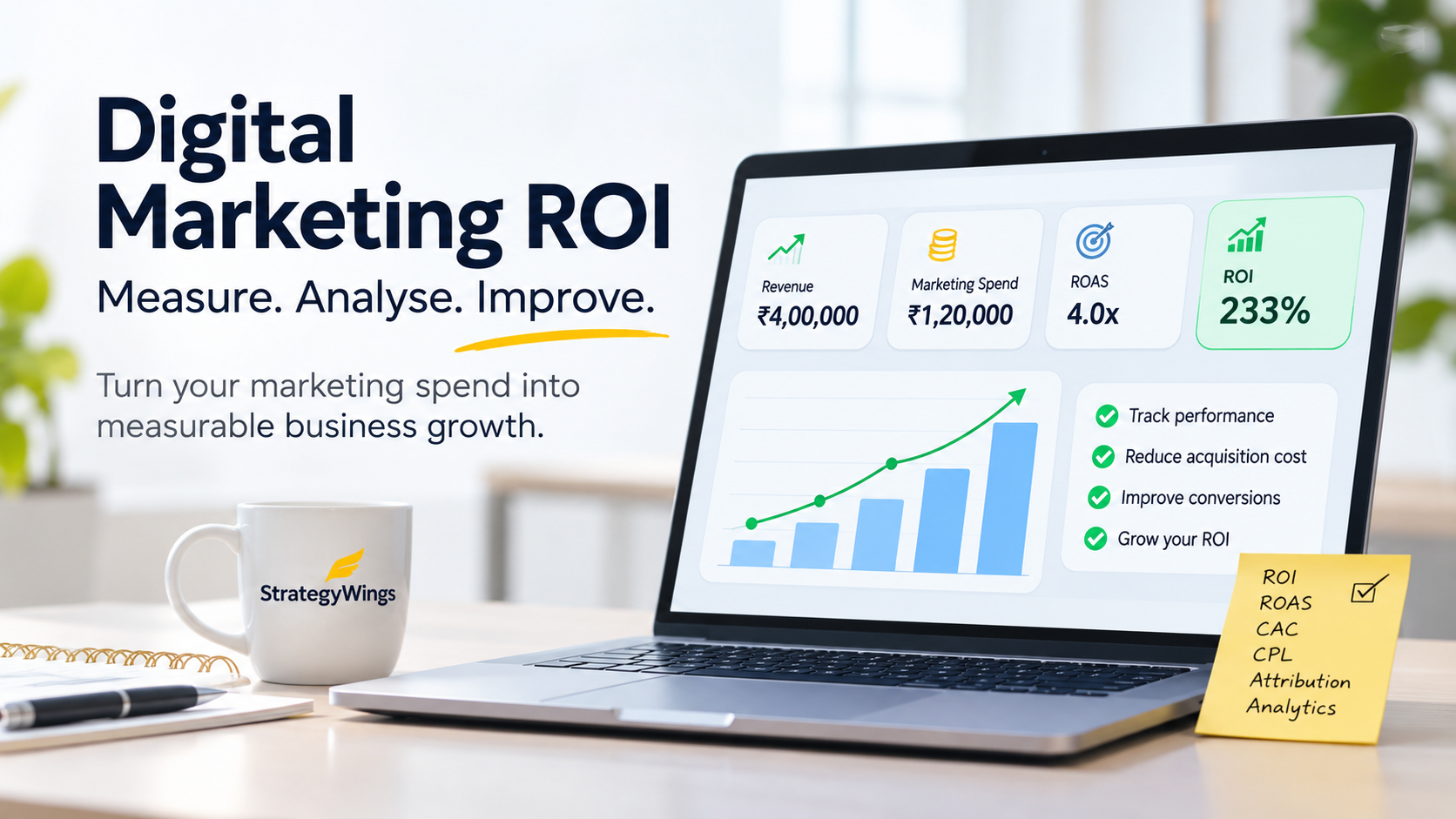
| Total Marketing Investment | ₹1,20,000 |
| Revenue Generated | ₹4,00,000 |
| Orders Received | 100 |
| Average Order Value | ₹4,000 |
Calculate ROAS
ROAS = Revenue ÷ Advertising Spend
ROAS = ₹4,00,000 ÷ ₹1,00,000
ROAS = 4x
This means the business generated ₹4 in revenue for every ₹1 spent on advertising.
Calculate Marketing ROI
ROI = [(Revenue − Total Marketing Investment) ÷ Total Marketing Investment] × 100
ROI = [(₹4,00,000 − ₹1,20,000) ÷ ₹1,20,000] × 100
ROI = 233.33%
At first glance, the results look promising.
But before increasing the advertising budget, the business should also check:
- Product manufacturing or purchase costs.
- Delivery and logistics expenses.
- Discounts and returns.
- Payment gateway charges.
- Gross profit margins.
- Repeat customer purchases.
For example, if product margins are low, a 4x ROAS may not be enough to generate healthy profits.
This is why businesses should evaluate marketing performance alongside their actual financial numbers.
9. Common Mistakes to Avoid When Measuring Marketing ROI
Even businesses with good marketing teams sometimes make mistakes when evaluating campaign performance.
Here are some common ones:
Focusing only on clicks and impressions: These metrics show visibility, not necessarily business results.
Ignoring additional expenses: Advertising expenditure is only one part of the total marketing investment.
Chasing the lowest CPL: Cheap leads are not always quality leads.
Not tracking sales conversions: Marketing performance should be connected with actual customer acquisition.
Ignoring customer lifetime value: A customer’s long-term value can be much higher than their first purchase.
Incorrect conversion tracking: Missing or duplicate events can make campaign reports unreliable.
Scaling campaigns too quickly: Increasing budgets without checking profitability can result in unnecessary spending.
Avoiding these mistakes can make your marketing reports more meaningful and your decisions more effective.
10. Make Marketing Decisions Based on Business Results
Successful digital marketing is not about running more campaigns or spending bigger budgets.
It’s about understanding your customers, knowing where your money goes and identifying which activities contribute to business growth.
Marketing, sales, operations and finance teams should work together to understand the complete customer journey.
When these teams share information, businesses can identify where leads are getting lost, which campaigns generate profitable customers and where improvements are needed.
The objective should always be to build a marketing system that delivers measurable and sustainable growth.
Conclusion
Digital marketing becomes much more effective when you understand what is actually working and what needs to change.
Tracking ROI, ROAS, CAC, CPL and conversion rates gives you a clearer picture of campaign performance. Connecting this information with CRM and sales data takes that understanding a step further.
Start with accurate tracking, review your performance regularly and focus on improving the quality of your leads and customers.
Remember, successful marketing isn’t about generating the highest number of clicks, impressions or inquiries.
It’s about turning your marketing investment into real business results.
At StrategyWings, we believe every marketing decision should have a clear business purpose. With the right strategy, performance tracking and continuous optimization, businesses can make smarter investments and build sustainable growth.
Looking to improve your marketing performance? Explore StrategyWings for digital marketing and business growth solutions.
Frequently Asked Questions
1. What is Digital Marketing ROI?
Digital Marketing ROI measures the financial return generated from marketing activities compared with the investment made in those activities.
2. How do I calculate marketing ROI?
Subtract your total marketing investment from the revenue generated, divide the result by your investment and multiply by 100.
3. What is a good ROAS for Google Ads?
There is no fixed ROAS that works for every business. It depends on product margins, operating expenses, customer acquisition costs and profitability targets.
4. What is the difference between CPL and CAC?
CPL measures the cost of generating a lead, while CAC measures the total cost of acquiring a paying customer.
5. Which tools are best for tracking marketing ROI?
Google Analytics 4, Google Tag Manager, Google Ads, Meta Ads Manager, Google Looker Studio and CRM platforms such as Zoho CRM are useful options.
6. How can a small business improve marketing ROI?
Focus on the right audience, improve website conversion rates, optimize advertising campaigns, invest in SEO, automate lead follow-ups and build stronger customer relationships.
7. How often should I measure marketing ROI?
Review campaign performance weekly and overall marketing ROI monthly. Businesses with longer sales cycles should also consider quarterly performance and customer cohort analysis.
Leave a Reply