

Every business wants the same thing from its marketing investment: more customers, higher revenue, and sustainable growth.
But when it comes to allocating a marketing budget, one important question often arises: should you invest in performance marketing or traditional marketing?
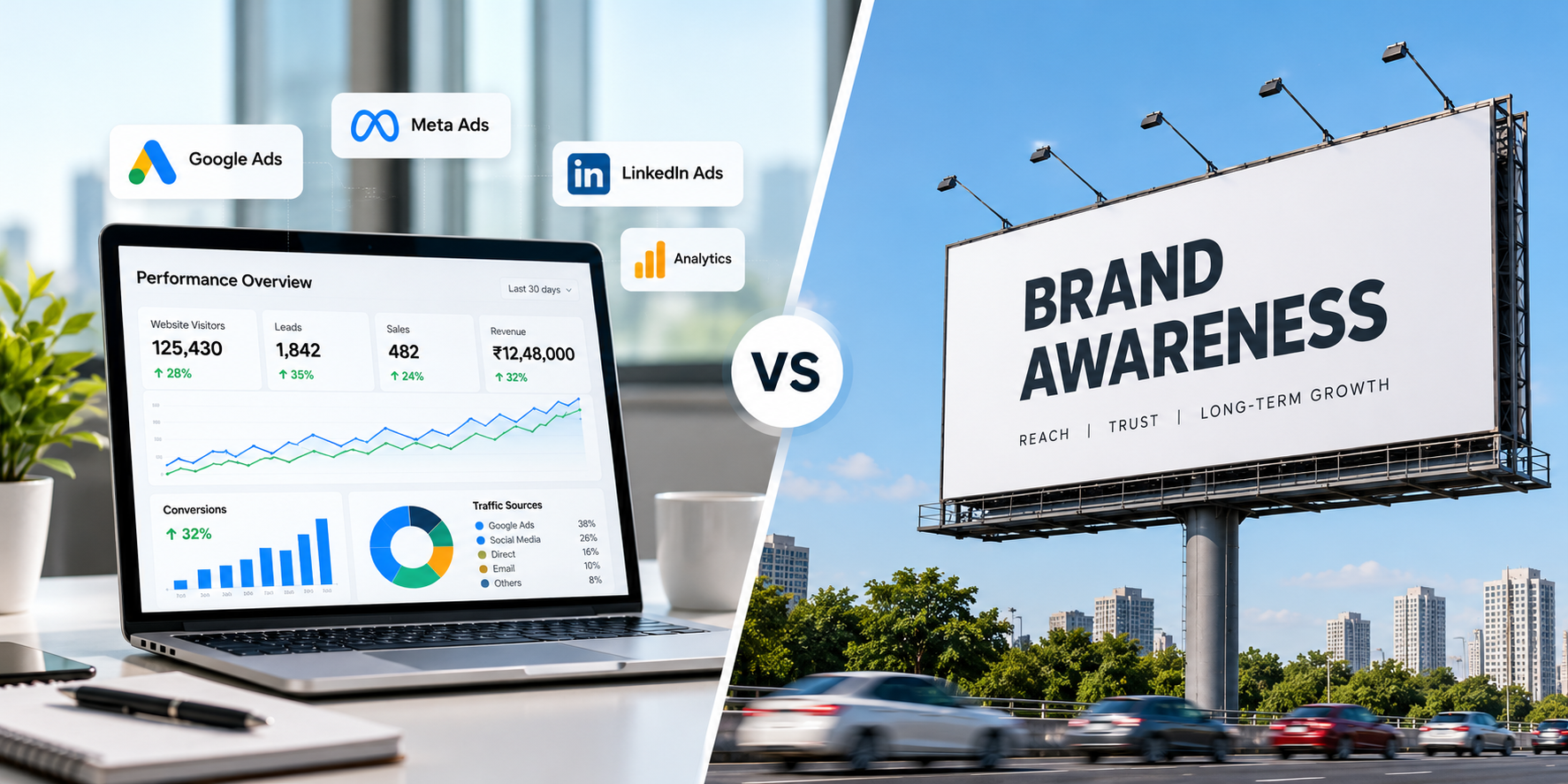
Traditional marketing has helped businesses build awareness and credibility through television, newspapers, radio, billboards, and print advertising. Performance marketing, on the other hand, focuses on measurable actions such as website visits, qualified leads, product purchases, and customer acquisition.
With businesses increasingly adopting digital channels and data-driven strategies, performance marketing has become an important part of modern marketing plans. However, traditional marketing still plays a valuable role in reaching broad audiences and building brand recognition.
The real question is not which approach is universally better, but which approach delivers the strongest return for your business goals.
In this article, we will compare both approaches, explore their advantages and limitations, and explain how businesses can build a marketing strategy that balances immediate results with long-term growth.
What Is Performance Marketing?
Performance marketing is a results-oriented marketing approach in which campaigns are planned, tracked, and optimized around measurable outcomes.
These outcomes may include leads, sales, website conversions, app installs, or other valuable customer actions.
Common performance marketing channels include:
- Google Ads and paid search campaigns
- Meta Ads on Facebook and Instagram
- LinkedIn Ads for B2B lead generation
- Affiliate and influencer marketing
- Conversion-focused landing pages
- Retargeting and remarketing campaigns
For example, an e-commerce company can run Google Shopping campaigns to promote its products. By tracking advertising spend, orders, revenue, and customer acquisition costs, the company can identify which campaigns generate profitable sales.
Similarly, a B2B consulting firm can use LinkedIn Ads and Google Search campaigns to attract business enquiries and measure how many leads turn into paying clients.
Key benefits of performance marketing
1. Measurable results: Businesses can monitor impressions, clicks, conversions, cost per lead, customer acquisition cost, and return on ad spend.
2. Precise targeting: Campaigns can target audiences using search intent, demographics, interests, professional characteristics, and relevant customer signals.
3. Faster optimization: Marketers can test different advertisements, audiences, offers, and landing pages to improve campaign performance.
4. Budget flexibility: Spending can be adjusted based on campaign results, business priorities, and available resources.
5. Scalability: Profitable campaigns can be expanded when there is sufficient demand, inventory, operational capacity, and acceptable acquisition costs.
However, performance marketing is not automatically profitable. Poor targeting, weak landing pages, low-quality leads, incorrect conversion tracking, and rising advertising costs can quickly reduce returns.
What Is Traditional Marketing?
Traditional marketing uses established offline channels to communicate with potential customers and build brand awareness.
Common examples include:
- Television and radio advertisements
- Newspaper and magazine advertisements
- Billboards and outdoor advertising
- Brochures, flyers, and direct mail
- Trade shows, exhibitions, and industry events
- Sponsorships and offline promotional campaigns
For example, a real estate developer may advertise a new residential project through outdoor hoardings, newspaper advertisements, and local events to reach people in a particular market.
A furniture manufacturer might participate in industry exhibitions to demonstrate products, connect with distributors, and build relationships with commercial buyers.
Key benefits of traditional marketing
1. Broad reach: Television, radio, and outdoor advertising can expose a brand to large audiences.
2. Brand credibility: Well-executed campaigns across established media can strengthen brand familiarity and trust.
3. Local market visibility: Outdoor advertisements, print campaigns, and community events can be effective for location-specific businesses.
4. Physical engagement: Trade shows and in-person demonstrations allow customers to experience products and interact directly with representatives.
5. Long-term brand building: Repeated exposure can help businesses remain familiar to customers before they are ready to purchase.
The primary challenge is measurement. Although traditional campaigns can be evaluated through tracked phone numbers, QR codes, promotional codes, surveys, and sales analysis, it may be harder to connect every customer interaction directly to a specific advertisement.
Performance Marketing vs. Traditional Marketing: Key Differences
| Factor | Performance Marketing | Traditional Marketing |
|---|---|---|
| Primary focus | Measurable actions and conversions | Awareness, reach, and brand familiarity |
| Common channels | Search, social ads, affiliate campaigns | TV, radio, print, outdoor ads |
| Targeting | Often highly granular | Frequently broader or location-based |
| Measurement | Digital tracking and attribution | Surveys, response tracking, and market analysis |
| Optimization | Campaign changes can be made quickly | Changes may require more time and expense |
| Budget control | Flexible campaign-level adjustments | Often involves fixed placements or production costs |
| Customer journey | Can target multiple stages of the funnel | Particularly useful for broad awareness and offline engagement |
| Best use cases | Lead generation, online sales, measurable acquisition | Mass awareness, local presence, physical engagement |
The distinction is not absolute. Traditional advertising can generate measurable responses, and digital marketing can build brand awareness. The difference lies mainly in how campaigns are designed, delivered, and evaluated.
Which Marketing Strategy Delivers Better ROI?
Performance marketing can be a strong choice when a business needs measurable leads, online sales, and relatively rapid feedback on campaign performance.
Traditional marketing can deliver substantial value when the objective is broad reach, brand recognition, local visibility, or engagement in environments where offline media is influential.
Research also cautions against assuming that digital channels always outperform traditional ones. Nielsen’s 2025 marketing effectiveness analysis highlights that some traditional channels, including radio, can deliver strong ROI despite being perceived as less effective by marketers. It also emphasizes the importance of balancing short-term performance with long-term brand building.
How to Calculate Marketing ROI
Before comparing marketing channels, businesses need a consistent way to evaluate financial returns.
A simple ROI formula is:
Marketing ROI = (Revenue Attributed to Marketing − Marketing Cost) ÷ Marketing Cost × 100
For example, suppose a company invests ₹1,00,000 in a campaign and generates ₹3,00,000 in attributable revenue.
- Revenue: ₹3,00,000
- Marketing cost: ₹1,00,000
- Return after marketing cost: ₹2,00,000
- Marketing ROI: 200%
This is a simplified calculation. It does not account for product costs, fulfilment, salaries, agency fees, or other business expenses unless those are included in the calculation.
It is also important to distinguish ROI from ROAS (Return on Ad Spend).
ROAS = Revenue Attributed to Ads ÷ Advertising Spend
If ₹1,00,000 in advertising generates ₹3,00,000 in revenue, the ROAS is 3x. That does not necessarily mean the business is profitable.
For a meaningful comparison, evaluate both channels using consistent cost definitions, attribution windows, revenue data, and profit margins.
Which Approach Is Better for Different Businesses?
1. E-commerce and D2C brands
Performance marketing is often a practical starting point because businesses can track product views, add-to-cart events, purchases, revenue, and acquisition costs.
Google Shopping, search advertising, paid social campaigns, and remarketing can help businesses understand which products and audiences are generating sales.
Traditional marketing can complement these activities through outdoor campaigns, print promotions, or brand-building initiatives that increase recognition and encourage subsequent online searches.
Recommended approach: Prioritize measurable acquisition while investing in brand-building activities as the business grows.
2. B2B companies and consulting firms
B2B companies often benefit from Google Search, LinkedIn Ads, content marketing, email campaigns, and targeted lead-generation strategies.
However, generating a large number of leads does not guarantee revenue. A campaign should also be evaluated on lead quality, sales-qualified opportunities, conversion rates, sales cycle length, and customer lifetime value.
Traditional marketing, including industry events, trade shows, and professional publications, can help establish credibility and create valuable business relationships.
Recommended approach: Use digital channels to capture demand and generate leads, supported by networking and industry events where appropriate.
3. Local businesses
Local businesses can use search advertising, local SEO, social media campaigns, and location-based targeting to reach potential customers.
Newspaper advertisements, local radio, flyers, and outdoor signs can also work when the target audience responds to these channels.
Recommended approach: Test the channels most relevant to local customer behaviour and track calls, enquiries, store visits, and sales.
4. Large enterprises and established brands
Large businesses often need both immediate sales and long-term market growth. Digital advertising can support acquisition and conversion, while television, outdoor media, sponsorships, and other brand campaigns can create wider awareness.
A balanced strategy helps prevent the business from focusing exclusively on short-term conversions while overlooking future demand.
Recommended approach: Combine performance marketing, brand building, and consistent cross-channel measurement.
Five Ways to Improve Marketing ROI
Regardless of the channels you choose, these practices can improve marketing effectiveness.
1. Define clear business objectives
Set measurable goals before launching a campaign. These might include revenue growth, qualified leads, lower acquisition costs, increased repeat purchases, or improved market awareness.
2. Track the complete customer journey
Use tools such as Google Analytics 4, Google Tag Manager, advertising platform reporting, and your CRM to connect marketing activity with business outcomes.
Where possible, track leads through to sales rather than evaluating campaigns only on clicks or form submissions.
3. Optimize conversion rates
Improving the website experience can increase the value of existing marketing traffic. Review page speed, mobile usability, product information, forms, calls to action, and checkout friction.
4. Measure profitability, not just volume
A campaign generating inexpensive leads may still perform poorly if those leads rarely convert into customers.
Monitor cost per qualified lead, customer acquisition cost, contribution margin, repeat purchases, and customer lifetime value where relevant.
5. Balance short-term results with long-term growth
Performance campaigns can capture existing demand, but brands also need to create future demand. Consistent brand-building activity can strengthen recognition, customer trust, and the effectiveness of conversion-focused campaigns.
The appropriate allocation varies by business, industry, maturity, and objectives. Avoid adopting a fixed budget split without evidence from your own marketing performance.
The Future of Marketing: Combining Performance and Brand Building
Modern marketing is moving beyond the idea that businesses must choose between immediate conversions and long-term brand growth.
Digital platforms offer increasingly sophisticated targeting, automation, and measurement capabilities. At the same time, businesses need to understand that not every customer purchases immediately after seeing an advertisement.
A potential customer might first encounter a brand through a video, later search for its products, read reviews, visit its website, and finally make a purchase after receiving a remarketing message or speaking with a sales representative.
If a business attributes all credit to the final click, it may undervalue the earlier interactions that influenced the decision.
An effective marketing strategy therefore combines campaign-level data with broader business indicators, customer research, and, where practical, incrementality testing or marketing mix modelling.
The objective is not simply to identify which channel receives credit for a sale. It is to understand which investments actually contribute to profitable, sustainable growth.
Conclusion: Which Marketing Strategy Should You Choose?
Performance marketing and traditional marketing serve different but complementary purposes.
Performance marketing is particularly useful for measurable acquisition, lead generation, e-commerce sales, and continuous campaign optimization. Traditional marketing remains valuable for broad awareness, local visibility, physical engagement, and long-term brand building.
For many businesses, the strongest strategy is an integrated approach that combines the accountability of performance marketing with the reach and brand-building potential of traditional channels.
Start with your business objectives, understand your customers, measure results consistently, and invest in the channels that contribute to profitable growth over an appropriate time horizon.
At StrategyWings, we believe marketing should be more than generating clicks or impressions. It should support measurable business outcomes and sustainable growth.
Ready to Improve Your Marketing ROI?
Whether you want to generate qualified leads, scale digital campaigns, improve conversion rates, or build a more effective marketing strategy, the right approach begins with understanding your business goals.
Book a Consultation with StrategyWings to explore how a data-driven marketing strategy can help your business grow.
Frequently Asked Questions (FAQs)
1. Is performance marketing better than traditional marketing?
Performance marketing is often better suited to directly measurable acquisition and conversion goals. Traditional marketing can be more suitable for broad awareness and offline engagement. The best choice depends on your objectives and audience.
2. Which marketing approach provides better ROI?
Neither approach guarantees better ROI in every situation. Results depend on campaign execution, audience fit, total costs, margins, attribution, and the period over which returns are measured.
3. Is performance marketing suitable for small businesses?
Yes. Small businesses can start with controlled budgets, focused targeting, and measurable objectives. They should ensure that tracking works correctly and that campaigns generate profitable customers rather than just clicks or enquiries.
4. Can traditional marketing results be measured?
Yes. Businesses can use unique phone numbers, QR codes, promotional codes, customer surveys, geographic comparisons, and sales trends to estimate the impact of traditional campaigns.
5. Can performance marketing and traditional marketing work together?
Yes. Traditional campaigns can build awareness and stimulate interest, while performance campaigns can help capture demand and convert interested audiences. Coordinated planning and measurement make it easier to evaluate their combined contribution.
6. What metrics should businesses use to evaluate marketing performance?
Useful metrics include marketing ROI, ROAS, customer acquisition cost, cost per qualified lead, conversion rate, revenue, contribution margin, customer lifetime value, and brand awareness. Select metrics that match your business objectives.
Leave a Reply