

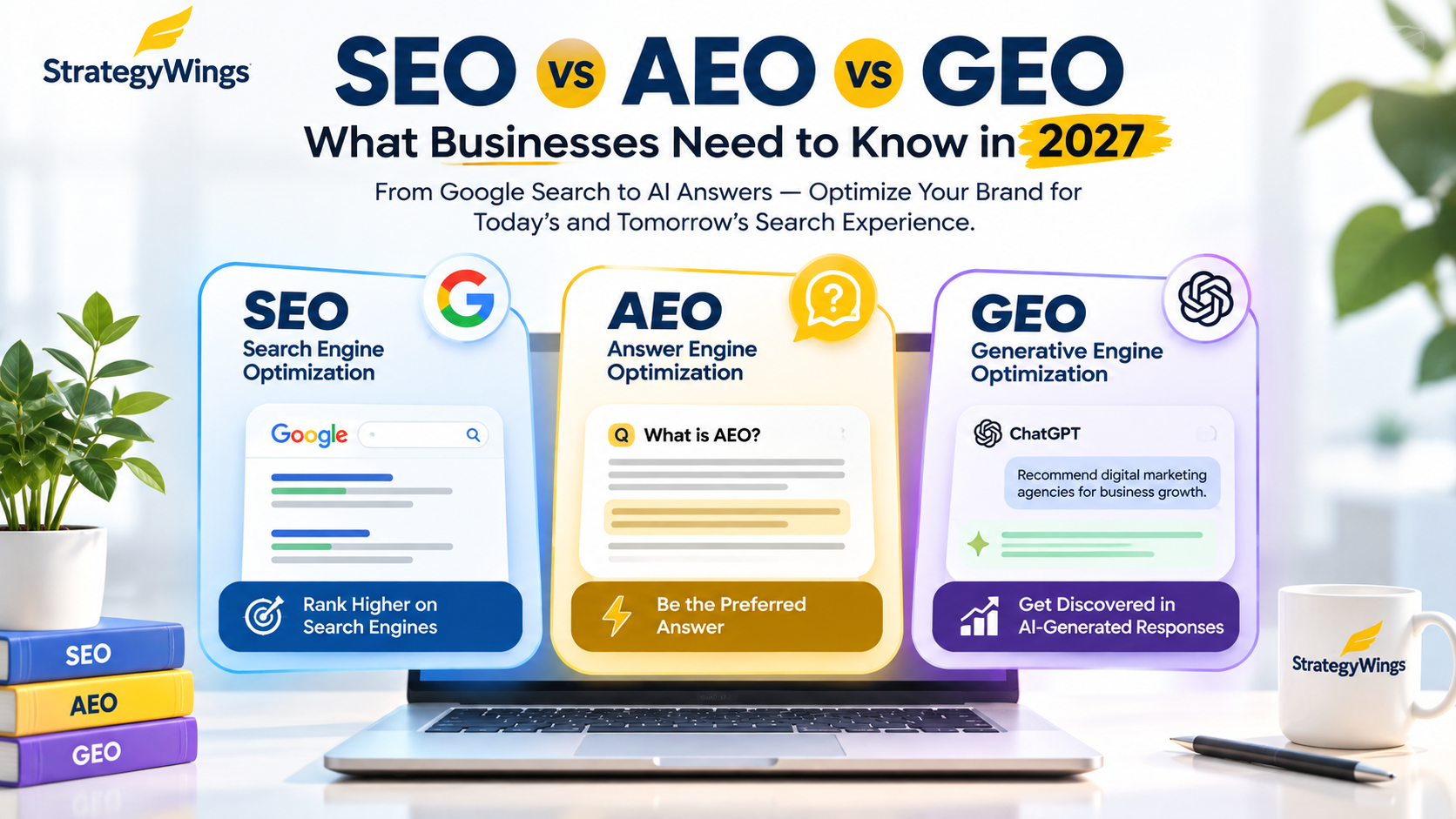
The way people search for information online is changing.
A few years ago, when someone wanted to find a product, compare services or learn something new, the first thing they usually did was open Google, type a keyword and browse through the search results.
Today, things are different.
People are increasingly asking questions directly to AI-powered platforms such as ChatGPT, Google AI Overviews, Microsoft Copilot and other conversational search tools. Instead of visiting multiple websites to find an answer, users can now receive summarized information, recommendations and relevant sources within a single conversation.
This shift is creating a new challenge for businesses: How do you make sure your brand gets discovered, not just on Google, but also through AI-powered search experiences?
That’s where three important concepts come into the picture:
- SEO – Search Engine Optimization
- AEO – Answer Engine Optimization
- GEO – Generative Engine Optimization
Although these terms are closely connected, each focuses on a different aspect of online visibility.
For businesses, understanding SEO vs AEO vs GEO is becoming an important part of building a sustainable digital marketing strategy for 2027 and beyond.
Let’s understand what they mean, how they work and what your business should do to stay visible.
1. What Is SEO (Search Engine Optimization)?
Search Engine Optimization, commonly known as SEO, is the process of improving your website’s visibility in search engine results.
When someone searches for a product, service or question on Google, search engines evaluate several factors to determine which pages are most relevant and useful.
The objective of SEO is to help your website appear for searches that matter to your business.
For example, imagine you run a digital marketing agency in Delhi.
When someone searches for:
- Digital marketing agency in Delhi
- SEO services for small businesses
- Google Ads management services
- Best digital marketing company near me
You want your website to appear when potential customers search for these services.
A well-planned SEO strategy helps improve your chances of reaching these audiences.
Key Elements of SEO
1. Keyword Research
Understand what your potential customers are searching for and identify relevant keywords based on their needs and search intent.
2. On-Page SEO
Optimize page titles, headings, meta descriptions, URLs, content, images and internal links.
3. Technical SEO
Make sure search engines can crawl, understand and index your website. Focus on website speed, mobile usability, site architecture and technical health.
4. Content Marketing
Publish useful articles, service pages, guides and resources that answer customer questions and demonstrate your expertise.
5. Off-Page SEO
Build your website’s authority through relevant backlinks, genuine brand mentions, digital PR and industry relationships.
6. Local SEO
Optimize your Google Business Profile, local landing pages, business information and customer reviews to attract location-based searches.
Example of SEO in Action
Suppose someone searches for “best office furniture manufacturer in Noida.”
If your website has a well-optimized commercial furniture page, useful product information, relevant content and strong local relevance, it has a better opportunity to appear in relevant search results.
The main objective of SEO: Help potential customers discover your website through traditional organic search results.
2. What Is AEO (Answer Engine Optimization)?
Answer Engine Optimization, or AEO, focuses on making your website content easier for search engines and AI-powered answer platforms to understand and use when responding to specific questions.
Traditional searches often begin with short keywords.
AEO focuses more on the actual questions people ask.
For example, instead of searching for:
“Digital marketing ROI”
A user might ask:
“How can a small business measure the return on its digital marketing investment?”
The user is looking for a direct and useful answer rather than a list of websites.
AEO helps structure your content so that important information is clear, relevant and easy to interpret.
Key Elements of AEO
1. Answer Real Customer Questions
Understand the questions your customers frequently ask about your products, services and industry.
Use customer conversations, sales queries, keyword research and search data to identify them.
2. Provide Clear and Direct Answers
Start important sections with a concise explanation before going into greater detail.
Avoid unnecessarily complicated language.
3. Use Question-Based Headings
Organize content around questions such as:
- What is SEO?
- How does digital marketing work?
- How much does SEO cost?
- Why is website optimization important?
4. Add Relevant FAQs
Include frequently asked questions on service pages and articles where they genuinely help users.
5. Use Structured Content
Use descriptive headings, meaningful lists, comparison tables and relevant structured data to make information easier to understand.
Structured data should accurately represent the visible content on your website. It does not guarantee an AI answer or featured placement.
Example of AEO in Action
Imagine someone asks an AI-powered assistant:
“What is the difference between SEO and PPC advertising?”
If your article provides a clear explanation, a useful comparison and reliable supporting information, it may be considered as a relevant source by an answer platform.
However, publishing an FAQ or using a particular heading structure does not guarantee that your content will be selected.
The main objective of AEO: Make your content useful and understandable when people are looking for direct answers.
3. What Is GEO (Generative Engine Optimization)?
Generative Engine Optimization, or GEO, focuses on improving your brand’s visibility within AI-generated responses.
Unlike traditional search results, generative AI platforms can combine information from multiple sources to create a summarized answer.
For example, a user might ask ChatGPT:
“Recommend reliable digital marketing agencies for an e-commerce business in India.”
The AI platform may consider relevant information from different websites, business profiles and other available sources before generating its response.
GEO aims to improve the chances that your business, expertise, content or products are discovered, understood and referenced in these AI-powered experiences.
Key Elements of GEO
1. Publish Original and Valuable Content
Don’t simply repeat information already available across hundreds of websites.
Share practical insights, industry experience, research, case studies and useful examples.
2. Build Brand Authority
Make your brand information consistent across your website, professional profiles, business listings and relevant industry publications.
3. Demonstrate Expertise
Publish content that reflects actual knowledge of your industry.
For example, a furniture manufacturer can share product comparisons, material guides, project case studies and buying advice.
4. Strengthen Your Online Presence
Build relevant mentions and references through genuine industry publications, professional communities, partnerships and trusted websites.
5. Make Your Website Accessible
Ensure important website content can be discovered and accessed by relevant search systems and crawlers.
For ChatGPT search visibility, review whether your website allows OpenAI’s OAI-SearchBot to access the relevant pages.
6. Provide Accurate Business Information
Keep your company details, products, services, contact information and location information updated wherever your business is represented.
Example of GEO in Action
Suppose a business owner asks an AI assistant:
“Which companies provide commercial office furniture and turnkey office interior solutions in Delhi NCR?”
If your business has relevant service pages, detailed project examples, consistent company information and useful industry content, it has a better opportunity to be considered in relevant AI-generated recommendations.
There is no guaranteed way to secure a recommendation. AI platforms use their own systems to select and present sources.
The main objective of GEO: Improve your brand’s discoverability, credibility and potential visibility across generative AI experiences.
4. SEO vs AEO vs GEO: What’s the Difference?
Although all three approaches support online visibility, their primary focus is different.
| Factor | SEO | AEO | GEO |
|---|---|---|---|
| Full Form | Search Engine Optimization | Answer Engine Optimization | Generative Engine Optimization |
| Main Focus | Organic search visibility | Direct answers | AI-generated responses |
| User Behaviour | Searches using keywords | Asks specific questions | Uses conversational prompts |
| Primary Goal | Improve search presence | Become a useful answer source | Improve AI brand visibility |
| Content Approach | Search-intent focused | Question-and-answer focused | Helpful, contextual and authoritative |
| Platforms | Google, Bing | Featured snippets and answer experiences | ChatGPT, Copilot and generative search |
| Key Measurement | Rankings, clicks, impressions | Answer visibility and referrals | AI citations, mentions and referrals |
The important thing to understand is that SEO, AEO and GEO are not three completely separate marketing activities.
They overlap.
Strong technical SEO, useful content, brand credibility and a clear website structure can support visibility across all three areas.
In fact, Google’s guidance for generative AI search emphasizes that established SEO fundamentals remain important. It does not require businesses to follow separate AEO or GEO tricks to appear in Google’s AI search features.
5. How Search Behaviour Is Changing in 2027
Customer behaviour is becoming more conversational.
Instead of searching only for individual keywords, users are increasingly asking detailed questions and expecting personalized, contextual responses.
Consider these examples:
| Traditional Search | AI-Powered Search |
|---|---|
| Best CRM software | Which CRM is suitable for a small business with a five-person sales team? |
| SEO agency Delhi | Recommend an SEO agency for an e-commerce business in Delhi NCR. |
| Office furniture price | What should I consider before buying ergonomic office furniture for 50 employees? |
| Digital marketing ROI | How can I reduce customer acquisition costs while improving marketing profitability? |
This change creates new opportunities for businesses.
A customer may discover your brand through a Google search, encounter your content in an AI-generated summary or ask ChatGPT for recommendations.
Your digital presence should be prepared for all these discovery journeys.
Search Platforms Businesses Should Pay Attention To
Google Search and AI Overviews
Google continues to combine traditional search experiences with AI-generated summaries and conversational search features.
ChatGPT Search
Users can ask questions conversationally and discover relevant websites and sources through ChatGPT’s search experience.
Microsoft Copilot
Copilot provides AI-powered assistance and can surface information from websites across supported search experiences.
Other AI-Powered Discovery Platforms
Businesses should also pay attention to emerging AI assistants and search experiences as customer behaviour evolves.
The objective is not to optimize for every platform separately. It is to build a strong, accessible and trustworthy digital presence.
6. How to Optimize Your Website for SEO, AEO and GEO
The best approach is to create one integrated strategy rather than managing three disconnected optimization projects.
Here are practical steps businesses can start implementing.
Step 1: Strengthen Your Technical SEO Foundation
Before focusing on AI search visibility, make sure your website is technically sound.
Review:
- Website crawlability and indexability.
- XML sitemap configuration.
- Robots.txt settings.
- Mobile responsiveness.
- Page loading performance.
- HTTPS security.
- Canonical tags.
- Internal linking.
- Broken links and redirects.
If search engines cannot properly access your important pages, your visibility efforts may be limited.
Step 2: Create Content Around Search Intent
Don’t create content just because a keyword has search volume.
Understand why someone is searching.
For example, someone searching for “best salon chairs” may be comparing products, while someone searching for “how to choose a salon chair” may need buying guidance.
Create content that addresses different stages of the customer journey:
- Awareness: Educational blogs and industry guides.
- Consideration: Comparisons, product guides and case studies.
- Decision: Service pages, pricing information and testimonials.
This approach supports both traditional search and AI-driven discovery.
Step 3: Structure Content to Answer Questions
Make your content easy to navigate and understand.
Use:
- Clear H1, H2 and H3 headings.
- Descriptive section titles.
- Short paragraphs.
- Relevant bullet points.
- Comparison tables.
- Accurate FAQs.
- Direct explanations of important concepts.
For example, instead of writing a long paragraph about conversion rate optimization, create a dedicated section titled:
“What Is Conversion Rate Optimization and Why Does It Matter?”
Then provide a direct explanation followed by practical details.
Step 4: Build Topical Authority
Publishing one article on a topic is rarely enough to establish strong subject coverage.
Build related content around your main business services.
For example, a digital marketing agency can develop a content cluster around SEO:
- What Is SEO and How Does It Work?
- Technical SEO Checklist.
- On-Page SEO Best Practices.
- Local SEO for Small Businesses.
- SEO vs AEO vs GEO.
- How to Measure SEO Performance.
- Common SEO Mistakes Businesses Should Avoid.
Connect these articles using relevant internal links.
This helps users explore related information and makes your website structure easier to understand.
Step 5: Build Genuine Brand Authority
AI discovery is not just about individual blog articles.
Your brand’s overall online presence matters.
Focus on:
- Complete About Us and service pages.
- Genuine customer testimonials.
- Detailed case studies.
- Author information and professional experience.
- Relevant industry publications.
- Consistent company information.
- Useful original research and insights.
Avoid purchasing irrelevant backlinks or creating artificial brand mentions just to influence AI recommendations.
Step 6: Optimize Your Website for AI Crawlers
Review how different search and AI platforms access your website.
For ChatGPT search, check your robots.txt file and hosting or CDN configuration to ensure that OAI-SearchBot is not unintentionally blocked.
A basic robots.txt example for allowing this crawler is:
User-agent: OAI-SearchBot
Allow: /
This is only an example. Review your existing robots.txt rules before making changes.
Also remember that OAI-SearchBot and GPTBot serve different purposes. Allowing search access does not mean you must allow content crawling for model training.
Crawler access makes your pages eligible for discovery, but it does not guarantee that they will appear in AI responses.
Step 7: Use Structured Data Where Relevant
Structured data helps search engines understand specific information about your website.
Depending on your business, relevant schema types may include:
- Organization
- LocalBusiness
- Product
- Article
- BreadcrumbList
- Service
Use schema only where it accurately represents visible website content and follows the relevant platform guidelines.
Don’t add unnecessary schema or expect special AI rankings from it.
Step 8: Monitor Performance and Improve Continuously
Optimization should be an ongoing process.
Track both traditional search performance and emerging AI visibility indicators.
Look at:
- Organic impressions.
- Organic clicks.
- Keyword rankings.
- Organic conversions.
- Brand search growth.
- AI citations and mentions.
- AI referral traffic.
- Qualified leads generated from organic and AI discovery.
Use actual business outcomes to understand whether your visibility is bringing valuable customers.
7. How to Measure SEO, AEO and GEO Performance
One of the biggest challenges with AI search optimization is measurement.
Traditional SEO has well-established metrics such as rankings, impressions, clicks and organic traffic.
AI search requires some additional monitoring.
Here is a practical measurement framework.
| Area | Important Metrics | Useful Tools |
|---|---|---|
| SEO | Rankings, impressions, clicks, organic traffic | Google Search Console, GA4 |
| AEO | Answer visibility, relevant impressions, featured snippets | Search Console, manual query monitoring |
| GEO | AI citations, brand mentions, referral traffic | Bing Webmaster Tools, GA4, manual AI testing |
| Business Impact | Qualified leads, sales, conversion rate | CRM, GA4, Looker Studio |
Tools Worth Using
Google Search Console: Monitor organic search performance and, where available, visibility from Google’s generative AI search features.
Google Analytics 4: Understand website visitors, referral traffic and conversions.
Bing Webmaster Tools: Monitor search performance and use its AI Performance reporting to understand how your pages are cited in supported AI-generated answers.
Google Looker Studio: Combine marketing data into an easy-to-understand dashboard.
CRM Platforms: Connect website inquiries with qualified leads, sales opportunities and actual revenue.
For AI visibility, also test a consistent set of customer questions across relevant platforms. Record whether your brand appears, which pages are cited and how your competitors are represented.
AI answers can change between searches, so treat these checks as directional observations rather than fixed rankings.
8. Common SEO, AEO and GEO Mistakes Businesses Should Avoid
As interest in AI search grows, many businesses are rushing to implement new optimization techniques.
Some of these approaches can waste time and resources.
Here are mistakes worth avoiding.
1. Abandoning Traditional SEO
SEO remains an important foundation for search visibility. Do not stop investing in technical optimization, useful content and website quality.
2. Publishing AI-Generated Content Without Review
Using AI tools for research and content development can improve productivity. But publishing generic, repetitive or inaccurate articles can weaken your content quality.
Always add human expertise, original insights and fact-checking.
3. Chasing Keywords Without Understanding Intent
Ranking for irrelevant keywords may increase traffic without generating meaningful business opportunities.
Prioritize searches that match your customers’ actual needs.
4. Believing in Guaranteed AI Rankings
No agency or tool can guarantee that ChatGPT, Google AI Overviews or another AI platform will recommend your brand.
Be cautious of anyone promising guaranteed AI citations.
5. Ignoring Brand Authority
Your website is important, but your broader reputation also matters. Invest in useful content, genuine reviews, relevant mentions and consistent business information.
6. Overlooking Technical Accessibility
Important pages should be accessible to the relevant search crawlers. Check robots.txt, indexing, rendering and server restrictions.
7. Focusing on Visibility Instead of Conversions
Being mentioned by an AI platform is useful, but the ultimate business objective is attracting relevant prospects and generating customers.
Measure business outcomes alongside visibility.
9. A Practical 90-Day SEO, AEO and GEO Action Plan
Businesses don’t need to change their entire digital marketing strategy overnight.
Start with a structured 90-day plan.
Month 1: Audit and Foundation
Focus on understanding your current website performance.
- Conduct a technical SEO audit.
- Review indexed pages and crawlability.
- Identify important keyword opportunities.
- Audit existing website content.
- Review robots.txt and crawler access.
- Check GA4 and Search Console configuration.
- Establish a baseline for organic and AI visibility.
Expected outcome: A clear understanding of website health, existing visibility and improvement opportunities.
Month 2: Content and Authority Development
Start improving your content and website structure.
- Optimize important service pages.
- Publish question-based content.
- Develop relevant topic clusters.
- Add useful FAQs.
- Improve internal linking.
- Publish original case studies.
- Update author and company information.
- Implement relevant structured data.
Expected outcome: More useful content, stronger topical coverage and improved information accessibility.
Month 3: AI Visibility and Performance Measurement
Focus on evaluating the impact of your improvements.
- Monitor Google Search performance.
- Review generative AI visibility reports where available.
- Check Bing AI Performance reports.
- Test relevant queries across ChatGPT and other AI platforms.
- Track brand mentions and cited URLs.
- Monitor AI referral traffic.
- Connect leads with CRM data.
- Identify content and service pages that need further improvement.
Expected outcome: A measurable optimization process that connects search visibility with business performance.
10. What Should Businesses Prioritize in 2027?
The biggest mistake businesses can make is treating SEO, AEO and GEO as completely separate marketing strategies.
Instead, think about the complete customer discovery journey.
A customer might find your business through Google, learn about your services through an educational article, compare options using an AI assistant and finally contact you through your website.
Your brand should provide a consistent and useful experience at every stage.
For 2027, businesses should prioritize five things:
- Strong SEO foundations: Maintain technical website health and useful organic content.
- Question-focused content: Answer real customer questions with clear and reliable information.
- Brand authority: Build credibility through expertise, case studies and genuine industry recognition.
- AI accessibility: Ensure relevant platforms can discover your important website content.
- Business-focused measurement: Connect search visibility with qualified leads, sales and revenue.
The businesses that combine these areas will be better prepared for changes in how people discover information online.
Conclusion
Search is evolving, but one thing hasn’t changed: people still want reliable information and businesses that understand their needs.
SEO helps your website become discoverable through search engines. AEO helps make your content useful for answer-based search experiences. GEO focuses on improving your brand’s visibility within generative AI platforms.
These approaches work best when they are supported by the same fundamentals: useful content, technical accessibility, genuine expertise and a strong online reputation.
You don’t need to abandon traditional SEO to prepare for AI search. You need to build on it.
At StrategyWings, we believe the future of digital growth belongs to businesses that combine smart strategy, technology and meaningful customer experiences.
Whether your goal is better Google rankings, stronger AI search visibility or more qualified business leads, the right optimization strategy can help your brand stay discoverable as search continues to evolve.
Ready to improve your brand’s visibility across search engines and AI platforms? Explore StrategyWings and take the next step towards smarter digital growth.
Frequently Asked Questions (FAQs)
1. What is the difference between SEO, AEO and GEO?
SEO focuses on improving organic search visibility. AEO focuses on making content useful for direct answers and answer-based search experiences. GEO focuses on improving brand and content visibility in generative AI responses.
2. Is SEO still important in 2027?
Yes. SEO remains an important foundation for online visibility. Technical accessibility, useful content, relevant keywords, website quality and authority continue to support search discovery, including generative AI search experiences.
3. How can my business appear in ChatGPT search results?
Make sure your website is publicly accessible, important pages are indexable and OAI-SearchBot is not blocked by robots.txt or your hosting infrastructure. Publish relevant, reliable content and maintain a credible online presence. Inclusion is not guaranteed.
4. What is Generative Engine Optimization?
Generative Engine Optimization is the practice of improving the discoverability and visibility of a brand or its content in AI-generated responses across platforms such as ChatGPT, Copilot and generative search experiences.
5. Does AEO replace traditional SEO?
No. AEO complements SEO by placing additional emphasis on answering user questions clearly. A strong SEO foundation remains valuable for both traditional and AI-powered search.
6. How do I optimize my website for Google AI Overviews?
Follow Google’s established SEO best practices. Ensure your content is crawlable and indexable, publish useful and original information, maintain good internal linking and make important content available in text. There is no special AI schema or separate optimization requirement that guarantees inclusion.
7. Is schema markup important for AEO and GEO?
Structured data can help search engines understand website content and support eligible rich results. However, there is no special schema markup that guarantees visibility in AI-generated answers.
8. How long does it take to see results from SEO, AEO and GEO?
There is no fixed timeline. Results depend on your website’s current condition, competition, content quality, authority, technical accessibility and search platform. Treat optimization as an ongoing investment rather than a one-time activity.
9. Which tools can help monitor AI search visibility?
Google Search Console provides reporting for Google’s generative AI search features. Bing Webmaster Tools offers AI Performance reporting for supported AI experiences. GA4 can help track referral traffic and conversions. Manual prompt testing can provide additional directional insights.
10. Should small businesses invest in GEO?
Small businesses can benefit from improving their AI search visibility, especially when customers use AI assistants to research products and services. Start with good SEO, accurate business information, useful content and genuine brand authority before investing in specialized GEO tools.
Leave a Reply